
Most buyers know the regular slotted carton, but it isn't always the right box. The carton style decides how the box closes, how much board it uses, how well it stacks and how fast your team can pack it. This guide compares the styles we manufacture side by side, so you can pick one before you ask for a quote.
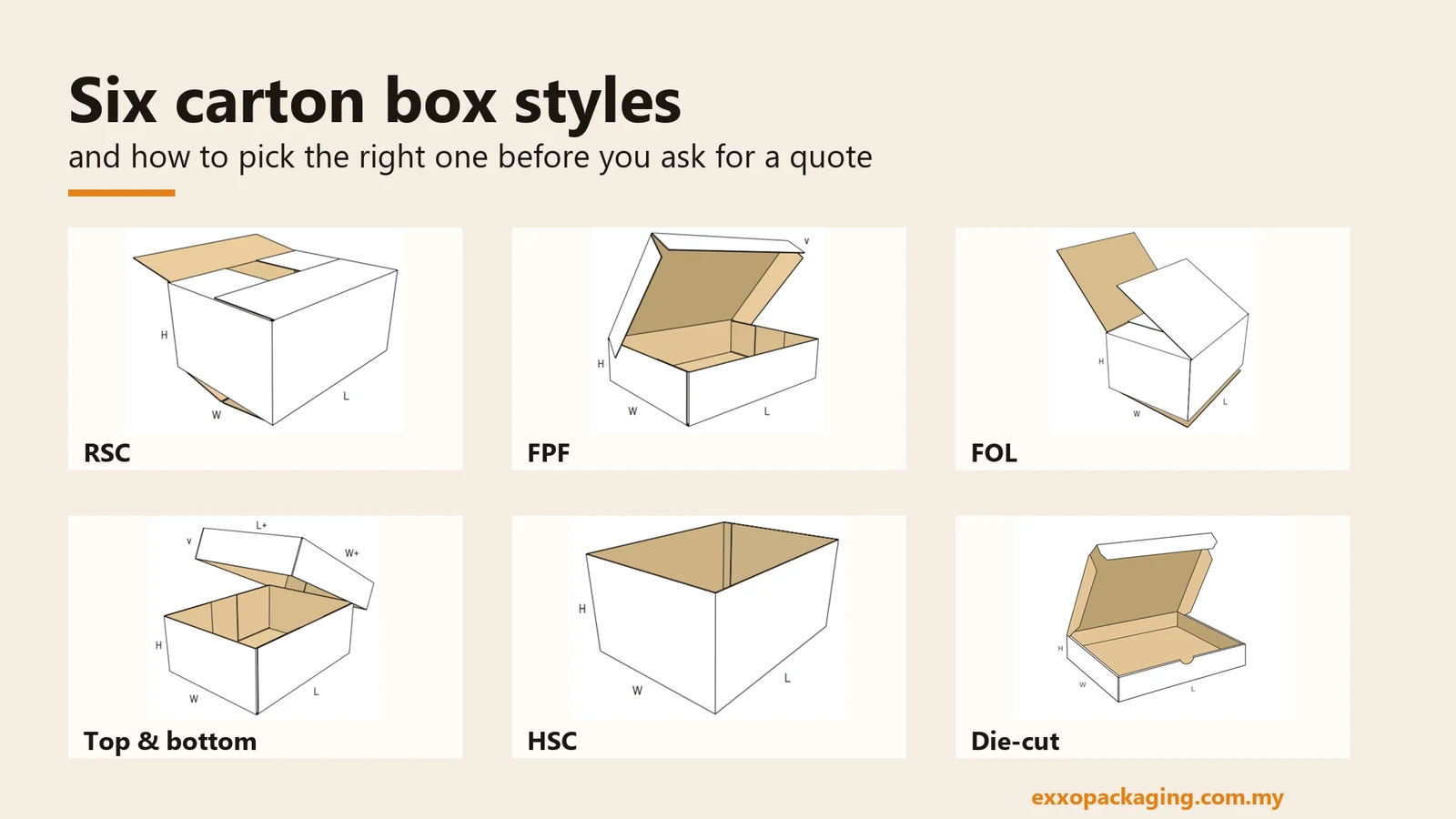
Which carton box style should I choose?
For most shipping, choose an RSC: it uses board efficiently and suits almost any product. Choose an FPF for long, flat products, an FOL for heavy loads that stack high, a top & bottom box for premium or heavy goods that need a lid, an HSC when the box needs an open top, and a die-cut box when presentation or a snug, tape-free fit matters.
| Style | How it closes | Best for | Board use |
|---|---|---|---|
| RSC (regular slotted, FEFCO 0201) | Four flaps top and bottom; the outer flaps meet in the centre | General shipping, storage, e-commerce | Low: the most efficient style |
| HSC (half slotted, FEFCO 0200) | Flaps on the bottom only; the top is open | A base with a separate lid, or tall items loaded from the top | Lower than an RSC (no top flaps) |
| FPF (five panel folder, FEFCO 0409) | Wraps around the product; the fifth panel closes over the top | Long or flat items: frames, panels, profiles, books | Efficient for long, flat items |
| FOL (full overlap, FEFCO 0203) | Outer flaps overlap across the full width | Heavy contents and high stacks | Higher (full-width flaps) |
| Top & bottom | A separate tray and lid that slide together | Premium, heavy or awkward goods | Higher (two pieces) |
| Die-cut | Custom shape with tuck flaps or locks, often no tape | Mailer boxes, retail and food boxes, inserts and trays | Varies; needs a cutting die |
Why is the RSC the default carton?
The RSC is cut from one rectangular blank with almost no waste, so it gives you the most box for the board you pay for. It folds flat for storage, assembles quickly by hand, and suits any of our flutes, from E flute single wall to BA double wall. That's why it covers most shipping, warehouse and e-commerce packing.
Where it falls short: the outer flaps only meet in the middle, so the top and bottom are a single layer of board in the centre. For very heavy contents or tall stacks, an FOL or double wall board adds strength. For long, flat products, an RSC often ends up deep and mostly empty.
Not sure of the size? Our free carton size calculator works out an RSC size from your product size and quantity.
When is a five panel folder (FPF) better than an RSC?
When the product is long and flat. An FPF wraps around the product instead of forming a deep box, so picture frames, panels, mirrors, aluminium profiles and flat-pack parts sit snugly with little empty space. The overlapping panels give a double layer of board on the top and bottom.
Where it falls short: it's slower to pack than an RSC, and it isn't suited to loose or cube-shaped products. You can preview an FPF in 3D with our carton box design tool.
When should I use a full overlap (FOL) carton?
When the load is heavy or stacked high. The outer flaps overlap the full width of the box, so the top and bottom have two layers of board everywhere, not only in the middle. That adds stacking strength and protects the contents from punctures and rough handling.
Where it falls short: it uses more board than an RSC of the same size. Before you choose it, check whether a stronger board would do the job instead. Our guide to single wall vs double wall cartons explains that choice.
What are top & bottom and half slotted cartons used for?
A top & bottom box is a separate tray and lid that slide together. It looks neat, lifts off easily for inspection, and the doubled walls where the lid overlaps add strength. It suits premium goods, heavy items and gift packs.
A half slotted carton (HSC) is an RSC without the top flaps. It's used as the base of a two-piece box, or for tall items loaded from the top and covered with a separate lid or sheet.
For pallet loads, add layer pads: flat corrugated sheets between layers that spread the weight and stop cartons shifting.
When is a die-cut box worth it?
When the box is part of the product experience, or when the fit has to be exact. A die-cut box is cut to a custom shape with a cutting die, so it can have tuck flaps, locking tabs, handles and built-in inserts, and it often closes without tape. Mailer boxes, pizza-style boxes, promotional boxes and trays are all die-cut.
The die is a one-off cost. We keep your die in-house for repeat runs, and we sample before every full production run. Our guide to choosing a carton box covers when a die-cut box pays for itself over an RSC, and our die cutting service page shows the shapes we make.
How do I choose for my product?
- General products, shipped in volume? RSC.
- Long, flat or framed items? FPF.
- Heavy contents or tall stacks? FOL, or an RSC in double wall board.
- Premium goods, or a lid that lifts off? Top & bottom.
- Open-top base or tall items loaded from above? HSC.
- Presentation, tape-free assembly or a custom insert? Die-cut.
Still not sure? Tell us what you pack, how much it weighs and how it's stacked and shipped. We'll recommend a style and board, and we make all of these styles to your size at our Selangor plants.